

AMOLED vs OLED vs LCD: What Is the Display Difference?
When buying a smartphone, tablet, laptop, or TV, you may see display types such as AMOLED, OLED, and LCD. But what do these terms actually mean? Understanding the difference between AMOLED vs OLED vs LCD can help you choose a device with the right display for your needs.
Each display technology works differently and has its own advantages and disadvantages. Let’s look at them in simple terms.
What Is an OLED Display?
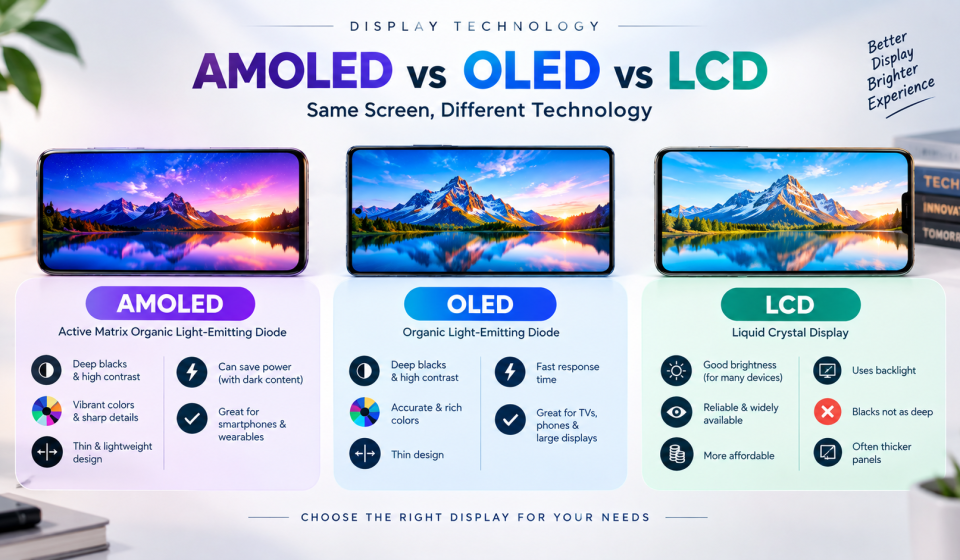
OLED stands for Organic Light-Emitting Diode. Unlike traditional LCD screens, OLED displays do not need a separate backlight.
Each pixel can produce its own light. This allows OLED screens to show deep black colors because individual pixels can be turned off when displaying black.
OLED displays are commonly found in premium smartphones, TVs, and other modern devices.
Advantages of OLED
- Deep and accurate black levels
- High contrast
- Good picture quality
- Thin display design
- Fast response time
Disadvantages of OLED
- Usually more expensive than LCD
- Some OLED displays can experience burn-in with long-term use
- Brightness can vary depending on the display and device
What Is AMOLED?
AMOLED stands for Active-Matrix Organic Light-Emitting Diode. It is a type of OLED display that uses an active-matrix system to control individual pixels.
AMOLED displays are widely used in smartphones and smartwatches. They can provide strong contrast, vibrant colors, and deep blacks while allowing manufacturers to create thin devices.
In simple words, AMOLED is a type of OLED technology, not a completely separate display category.
Advantages of AMOLED
- Deep blacks
- High contrast
- Vibrant colors
- Thin and lightweight design
- Can help save power when displaying darker content
Disadvantages of AMOLED
- Can be more expensive
- Burn-in can be a concern in some situations
- Color appearance depends on the display’s calibration
What Is an LCD Display?
LCD stands for Liquid Crystal Display. LCD screens use liquid crystals to control light from a separate backlight.
Because the backlight remains behind the display, LCD pixels cannot completely turn off the light in the same way as OLED pixels. This means black areas may appear lighter than they do on OLED displays.
LCD technology is still widely used in phones, laptops, monitors, TVs, and other devices.
Advantages of LCD
- Usually more affordable
- Reliable and widely available
- Good brightness on many devices
- No traditional OLED-style pixel burn-in
Disadvantages of LCD
- Blacks are usually not as deep as OLED
- Requires a backlight
- Display panels can be thicker
- Contrast is generally lower than many OLED displays
AMOLED vs OLED vs LCD: Key Differences
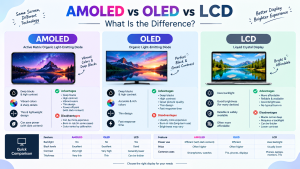
| Feature | AMOLED | OLED | LCD |
|---|---|---|---|
| Backlight | No | No | Yes |
| Black levels | Excellent | Excellent | Good |
| Contrast | Very high | Very high | Generally lower |
| Thickness | Very thin | Thin | Can be thicker |
| Power use | Can be efficient with dark content | Can be efficient | Uses backlight |
| Price | Often higher | Often higher | Usually more affordable |
| Common uses | Smartphones, watches | TVs, phones, displays | Phones, laptops, monitors, TVs |
Which Display Is Better?
There is no single display that is best for everyone.
If you want deep blacks, high contrast, and a premium viewing experience, an OLED or AMOLED display can be a great choice. These displays are especially useful for watching movies, playing games, and using a phone with dark themes.
LCD can be a better option if you want an affordable device with a good-quality display. Modern LCD panels can still provide excellent brightness, colors, and viewing quality.
When comparing devices, do not look at the display type alone. You should also consider brightness, resolution, refresh rate, color accuracy, screen size, and the overall quality of the panel.
Final Thoughts
The main difference in AMOLED vs OLED vs LCD comes from how each technology produces and controls light. OLED and AMOLED can produce very deep blacks and high contrast because their pixels can produce their own light, while LCD uses a separate backlight.
Before buying any device, you should first consider how you will use it and what tasks you need it for. Do not choose a device or display based only on its name. Different screens are designed for different purposes, so it is important to check the display quality, brightness, performance, features, price, and other specifications. Compare different options carefully, check what each one offers, and then choose the device that best matches your needs and budget.