

What Makes a Smartphone Fast? 5 Important Factors

What Makes a Smartphone Fast? 5 Important Factors Explained
Makes a Smartphone Fast 5 Important Factors Maybe you have used a phone with a high RAM and a powerful-looking processor but still felt like it was not very fast. Smartphone performance is not determined by just one factor.
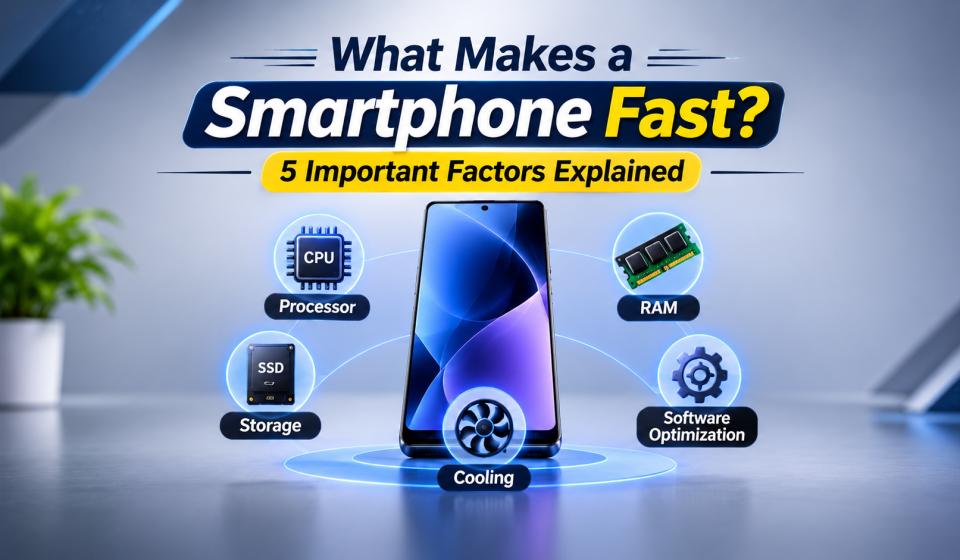
It is down to how well the components of your phone interact together, including the processor, RAM, storage, cooling, and software. Below are 5 important factors that can make your smartphone feel faster.
1. Processor: The Main Performance Engine
One of the main factors affecting how powerful your smartphone is will be the processor (also known as the chipset or SoC). This is used to run apps, play games, manipulate photographs, and do lots of other functions running in the background. Usually a newer, more advanced chipset will make heavy tasks much easier.
However, don’t be fooled by how fast it is (GHz) or how many CPU cores it has. The design can vary a lot between different processors, meaning they can perform very differently.
If you are going to be playing games, then make sure you pay attention to the GPU and sustained performance.
2. RAM: Helps with Multitasking
RAM is the phone’s short-term working memory. It helps the system keep apps and data ready while you switch between them.
For example, if you move from YouTube to Chrome and then return to YouTube, enough RAM can help the app stay available instead of loading everything again.
But more RAM does not automatically make every phone faster. A phone with 16GB RAM and a weak chipset can still perform worse than a well-optimized phone with 8GB RAM and a stronger processor.
For many users in 2026, 6GB–8GB RAM is a practical range, while heavier gaming and multitasking can benefit from more.
3. Storage Speed: The Hidden Performance Factor
Storage is not only about how many photos, videos, and apps your phone can hold.
Storage speed can also affect app launching, game loading, file transfers, and other operations that require data to be read or written quickly.
This is why two phones with similar processors and RAM can sometimes feel different in everyday use.
When buying a phone, look at both storage capacity and storage performance rather than focusing only on the number of gigabytes.
4. Cooling: Keeping Performance Stable
A phone can be very powerful at the beginning of a gaming session, but what happens after several minutes?
Heavy gaming, video editing, and other demanding tasks generate heat. When temperatures rise, a phone may reduce performance to control heat and power consumption.
This is known as thermal throttling. Good thermal design can help a phone maintain more consistent performance during longer workloads.
So, for gamers, cooling is more important than it may first appear.
5. Software Optimization: The Factor People Often Ignore
Hardware is only half of the story.
The operating system and software determine how efficiently the phone uses its processor, RAM, storage, and battery. Well-optimized software can make a phone feel responsive, while poorly optimized software can make powerful hardware feel less smooth.
This is also why two phones using similar hardware can provide different user experiences.
What About a 120Hz Display?
A 90Hz or 120Hz display can make scrolling, animations, and supported games look smoother, but refresh rate does not directly make the processor faster.
For example, a 120Hz screen can improve the feeling of smoothness, while the chipset determines much of the phone’s actual computing performance.
So, What Actually Makes a Phone Fast?
Think of smartphone performance as a team:
Processor + RAM + Storage + Cooling + Software
If these parts work well together, a phone can feel fast, smooth, and consistent in everyday use.
Instead of buying a phone simply because it has the highest RAM or the newest processor name, consider what you actually do with it. A student, casual user, gamer, and content creator may need different levels of performance.
Final Thoughts
A fast smartphone isn’t made by just one standout spec. It’s the combination of many factors:
Power from the processor, RAM to help with multitasking, fast loading from storage, cooling to keep performance up, and software that ties it all together.
Meaning sometimes it’s more useful to look at the whole package.