

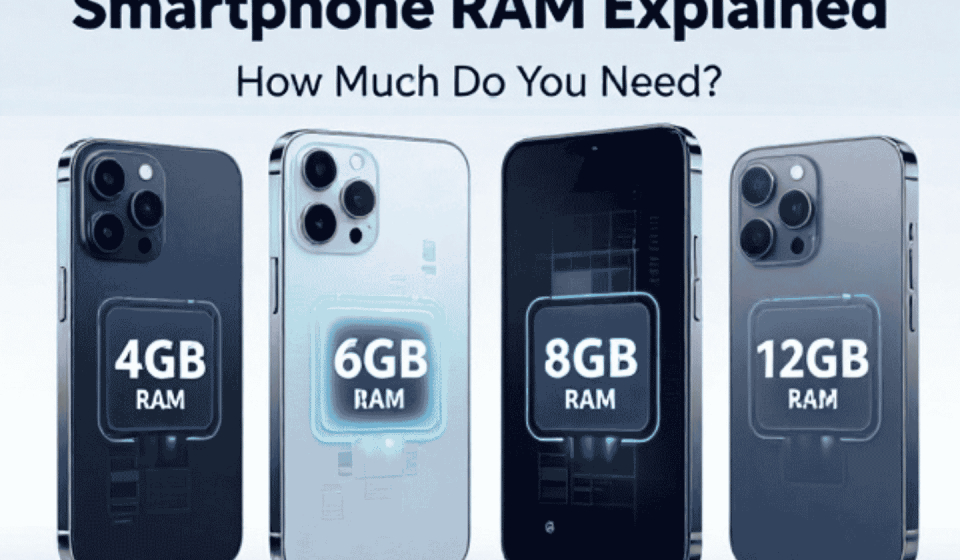

Smartphone RAM Explained: How Much Do You Need?
When buying a new smartphone, RAM is one of the specifications you will often see. Phones may come with 4GB, 6GB, 8GB, 12GB, or even more RAM. But does having more RAM always mean better performance?
Understanding smartphone RAM can help you choose a phone that matches the way you actually use it.
What Is RAM in a Smartphone?
RAM stands for Random Access Memory. It is a type of temporary memory that helps your smartphone handle apps and tasks that are currently running.
For example, if you open a browser, switch to a messaging app, and then return to the browser, RAM helps the phone keep those apps ready in the background.
RAM is different from your phone’s storage. Storage keeps things such as photos, videos, apps, and documents even when the phone is turned off. RAM is mainly used for active tasks.
Why does RAM matter on a smartphone?
Having enough RAM will give smooth multitasking. Having plenty of RAM means that more apps will be available in the background which makes switching between them much smoother.
But it isn’t all down to RAM. Other factors include the processor, software optimisation, storage and other hardware.
More RAM doesn’t mean it’ll be faster than lower RAM phones.
How Much RAM Do You Need?
The right amount depends on your daily use.
4GB RAM
A phone with 4GB RAM can be suitable for basic tasks such as:
- Calling and messaging
- Light web browsing
- Social media
- Watching videos
- Using simple apps
For heavier multitasking, however, you may notice more frequent app reloads.
6GB RAM
6GB can be a comfortable option for regular smartphone users.
It can handle everyday apps, browsing, social media, streaming, and moderate multitasking without requiring a very high-end device.
8GB RAM
8GB is a good choice for users who want more flexibility.
It can be useful for heavier multitasking, larger apps, gaming, and people who often switch between several applications.
For many users, 8GB offers a practical balance between performance and price.
12GB RAM or More
12GB or more can be useful for demanding users who regularly run heavy applications or games and want additional memory headroom.
However, not everyone needs this much RAM. If your daily activities are mostly messaging, browsing, social media, and video streaming, buying a phone with extremely high RAM may not provide a noticeable benefit.
Does More RAM Mean a Faster Phone?
Not necessarily.
Imagine two smartphones: one has 8GB RAM and another has 12GB. The 12GB model has more memory, but the 8GB phone could still feel faster if it has a better processor and better software optimization.
This is why you should look at the complete specification instead of choosing a phone based only on its RAM number.
RAM vs Storage: What Is the Difference?
These two specifications are often confused.
RAM helps the phone manage active apps and tasks.
Storage is where your files, apps, photos, videos, and other data are kept.
For example, a phone with 8GB RAM and 256GB storage has 8GB of working memory and 256GB of internal storage.
They perform different jobs, so one cannot simply replace the other.
Does Gaming Need More RAM?
Gaming can benefit from having enough RAM, especially when playing larger games or switching between a game and other apps.
However, RAM is only one part of gaming performance. The processor, graphics hardware, display refresh rate, cooling system, and software also matter.
A phone with a large amount of RAM may still provide a poor gaming experience if the other hardware is weak.
What About Virtual RAM?
Some smartphones offer a feature called virtual RAM or RAM expansion.
This feature uses a portion of internal storage to help with memory management when needed. It is not exactly the same as having additional physical RAM because storage is generally slower than dedicated RAM.
Therefore, do not choose a smartphone only because it advertises a very large combined RAM number.
Which RAM Size Should You Choose?
For many people, the choice can be simple:
- 4GB: Basic everyday use
- 6GB: Regular use and moderate multitasking
- 8GB: Multitasking, gaming, and longer-term flexibility
- 12GB+: Heavy users and demanding workloads
Your budget and actual usage should guide the decision.
Final Thoughts
Understanding smartphone RAM makes it easier to compare phones without being distracted by large numbers on a specification sheet.
More RAM can help with multitasking, but it does not work alone. Processor performance, software, storage, display, battery, and cooling can all affect the overall experience.
For most everyday users, choosing a phone with enough RAM for their needs is more sensible than simply buying the model with the highest number. A balanced smartphone can provide a better experience without unnecessary cost.



Comments are closed.
[…] choosing a gaming phone is not simply about finding the highest RAM or the biggest battery. The processor, GPU, display, cooling, battery, charging speed, and software […]
[…] RAM if you regularly […]