

What Is a Smartphone Refresh Rate? A Simple Guide
When choosing a new smartphone, you may notice specifications such as 60Hz, 90Hz, or 120Hz. These numbers are related to the phone’s display and can affect how smoothly everything appears on the screen. But what is a smartphone refresh rate, and why does it matter?
A refresh rate is an important display feature that can change your everyday smartphone experience. Whether you use your phone for browsing, watching videos, playing games, or reading, understanding this feature can help you make a better buying decision.
What Is a Smartphone Refresh Rate?
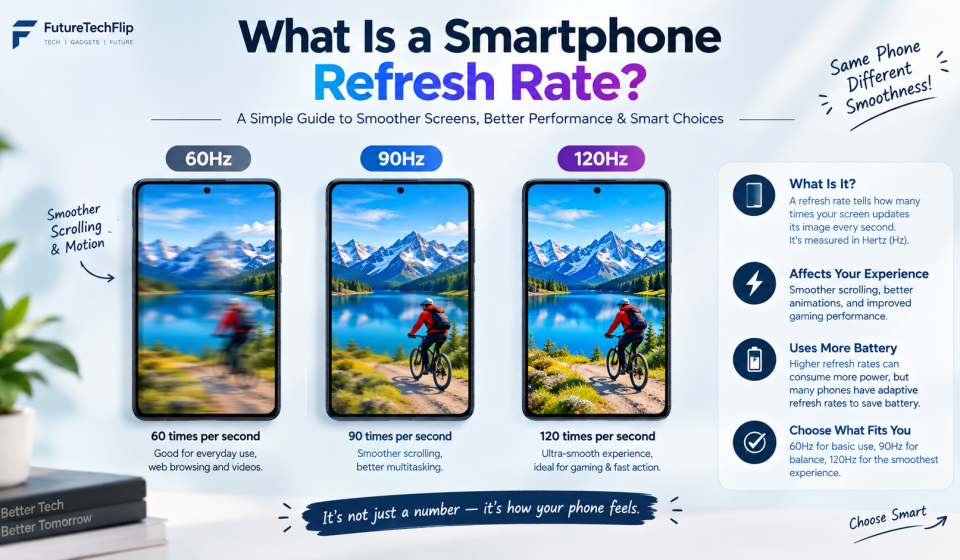
A smartphone refresh rate refers to how many times the screen updates its image every second. It is measured in Hertz (Hz).
For example, a 60Hz display refreshes its image 60 times per second, while a 120Hz display can refresh it 120 times per second.
In simple terms, a higher refresh rate can make movement on the screen look smoother. You may notice the difference when scrolling through social media, moving between apps, or playing supported games.
Understanding 60Hz, 90Hz, and 120Hz Displays
Different smartphones come with different refresh rate options. Here is what the common numbers mean.
60Hz Rate
A 60Hz display updates 60 times per second. It is suitable for everyday activities such as reading, browsing websites, watching videos, and using social media.
Many affordable smartphones still use 60Hz displays because they can provide a comfortable experience for regular tasks.
90Hz Rate
A 90Hz display updates 90 times per second. Compared with 60Hz, it can make scrolling and screen animations appear smoother.
It offers a middle option for people who want a smoother display without necessarily choosing a phone with a 120Hz screen.
120Hz Rate
A 120Hz display updates 120 times per second. It can provide smoother movement, especially when scrolling quickly or playing games that support higher frame rates.
However, a 120Hz display does not automatically make every app or video run at 120 frames per second.
Refresh Rate vs Frame Rate: What Is the Difference?
Refresh rate and frame rate are related, but they are not the same thing.
- Refresh Rate (Hz): How many times the screen can update every second.
- Frame Rate (FPS): How many individual frames a device or game produces every second.
For example, a phone may have a 120Hz display, but a game running at 60 FPS will produce only 60 new frames per second.
Both features can affect how smooth content looks, but they perform different jobs.
How Does Refresh Rate Affect Battery Life?
The refresh rate can influence how much battery power a smartphone uses.
A higher refresh rate may require more power because the display updates more frequently. This can affect battery life, although the actual result depends on the phone’s screen technology, processor, software, and usage.
Some modern smartphones include an adaptive refresh rate. This feature can automatically adjust the screen’s refresh rate depending on what you are doing.
For example, the phone may use a higher refresh rate while scrolling and a lower one when displaying a still image. This helps balance smooth performance and power consumption.
Does a Higher Refresh Rate Make a Smartphone Better?
Not always. A higher refresh rate can improve the visual experience, but it is only one part of a smartphone’s overall performance.
A phone with a 120Hz display may feel smoother than a similar phone with a 60Hz display. However, other features also matter, including:
- Processor and overall performance
- Display brightness and resolution
- Battery capacity and efficiency
- Camera quality
- Software support
- Price and build quality
You should compare the complete specifications instead of choosing a smartphone based on one number.
Which Refresh Rate Should You Choose?
The right refresh rate depends on your daily activities and budget.
If you mainly use your phone for calls, messages, reading, and browsing, a good-quality 60Hz display may be enough.
If you prefer smoother scrolling and regular multitasking, a 90Hz display can be a useful option.
If you enjoy supported high-frame-rate games or want smoother screen movement, a 120Hz display may be worth considering.
Remember that display quality, software optimization, and battery performance are also important.
Final Thoughts
Understanding what is a smartphone refresh rate can help you compare different phones more confidently. A 60Hz display is suitable for many everyday tasks, while 90Hz and 120Hz displays can offer smoother movement on the screen.
However, a higher number does not always mean a better smartphone. Consider your needs, budget, and the phone’s other specifications before making a decision. The best choice is the one that provides a comfortable experience for the way you use your device.